
What Programs Actually Work To Prevent Youth Violence?
Youth violence in Washington, DC is not an unsolvable mystery. It is a public health crisis with clear root causes, measurable risk factors, and proven solutions. Every day that passes without effective intervention costs young lives, shatters families, and destabilizes neighborhoods across the District.
For decades, communities have bounced between short-term fixes and overly punitive measures that fail to address why violence occurs in the first place. Band-Aids do not stop systemic trauma. Curfews and increased policing alone do not build stable, supportive environments where young people can thrive.
Real safety requires a shift toward evidence-based crime prevention. When local leaders invest in structured, continuous programs tailored to high-risk environments, violence drops. The science behind what works exists—the challenge now is putting those strategies into immediate action across Washington, DC.
The Science of Evidence-Based Crime Prevention
Stopping violence before it starts requires moving past guesswork. Evidence-based crime prevention relies on decades of empirical research, data collection, and rigorous field testing. These programs target the specific social, economic, and environmental conditions that drive youth toward violent behavior.
Effective interventions do not view at-risk youth as problems to be contained, but as individuals navigating intense adversity. By addressing trauma, family instability, and economic distress, these models interrupt the cycle of violence at its source.
Cognitive Behavioral Interventions
Cognitive Behavioral Therapy (CBT) adapted for community settings helps youth recognize emotional triggers and rewrite automatic responses to conflict. Programs using CBT teach emotional regulation, problem-solving, and impulse control, giving young people practical tools to de-escalate volatile situations.
Mentorship and Life-Skills Training
Sustained mentorship connects youth with trusted adults who provide guidance, accountability, and educational support. Paired with vocational training and life-skills development, mentorship creates viable alternatives to street involvement and economic desperation.
Community Violence Prevention That Yields Results
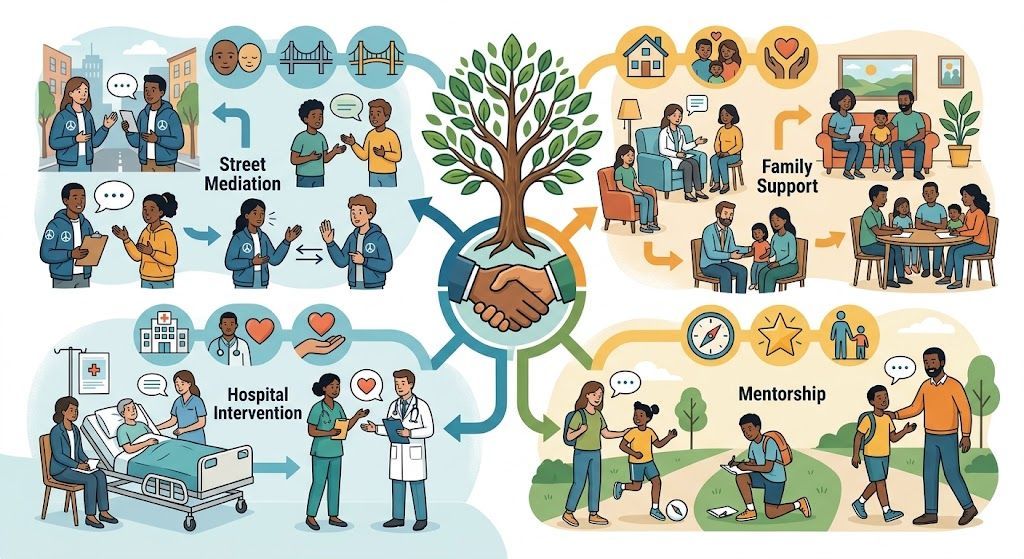
Top-down approaches rarely succeed without strong community roots. Community violence prevention mobilizes local residents, neighborhood leaders, and credible messengers—individuals who hold trust and authority within the community—to mediate conflicts directly on the ground.
These interventions operate on a street level. Credible messengers intervene in active disputes, prevent retaliatory violence, and connect individuals directly to wrap-around social services.
Hospital-Based Violence Intervention Programs (HVIPs)
When a young person enters a trauma center with a violent injury, the window for intervention is open. HVIPs place caseworkers directly at the bedside to provide immediate crisis counseling, prevent retaliation, and link the patient to long-term community support before they leave the medical center.
Environmental Design and Safe Spaces
Physical environments shape human behavior. Cleaning up vacant lots, improving street lighting, and creating safe, supervised community hubs reduce opportunities for violence while giving youth secure spaces to gather, learn, and play after school hours.
Designing Effective DC At-Risk Youth Programs

Not all youth programs achieve the same results. High-impact DC at-risk youth programs stand apart because they are intensive, continuous, and built around localized needs rather than generic templates.
Successful programs combine multiple layers of support: direct family engagement, academic tutoring, mental health resources, and job placement. They require long-term funding, institutional commitment, and deep local integration to create lasting stability.
Family-Centric Wraparound Services
Youth do not live in isolation. Programs that engage the entire family unit—offering parenting classes, household economic assistance, and family counseling—produce significantly stronger, longer-lasting outcomes than programs that focus strictly on the youth alone.
Year-Round Engagement Strategy
Violence does not take a break during the summer or after 3:00 PM. High-performing programs operate year-round, offering structured evening activities, summer employment options, and continuous support during peak hours of youth activity.
Implementing Proven Strategies in Washington, DC
Washington, DC faces unique geographical and socioeconomic dynamics, from Wards 7 and 8 to communities across the Anacostia River. Blanket strategies fail here; solutions must fit the hyper-local reality of District neighborhoods.
Youth violence prevention in Washington DC demands tight coordination between neighborhood leaders, public schools, and community organizations. By deploying field-tested models right here in the nation's capital, DC can lead the country in reducing youth crime while uplifting the next generation.
Partner With The Eisenhower Foundation to Protect Our Youth
Change does not happen without decisive action from local leadership. The Eisenhower Foundation brings decades of research, proven program models, and hands-on guidance to help DC policy makers, community organizers, local school boards, and Neighborhood Advisory Commissions (ANCs) establish effective youth violence prevention programs. Call us directly at 202-234-8104 to bring evidence-based solutions to your neighborhood.
Frequently Asked Questions
What is the most effective approach to youth violence prevention?
The most effective approach combines evidence-based cognitive behavioral therapy, street-level mediation by credible messengers, and comprehensive family support services. Single-track solutions rarely work on their own; multi-layered strategies yield the highest reduction in violent incidents.
How do community violence prevention programs differ from traditional policing?
Community violence prevention focuses on addressing the root causes of crime, resolving conflicts before they escalate, and rebuilding local infrastructure. While traditional policing reacts to crime after it occurs, community-led programs proactively reduce risk factors and foster long-term neighborhood stability.
How can local leaders in Washington, DC launch a youth program?
Local leaders can partner with experienced organizations like The Eisenhower Foundation to evaluate community needs, select proven program models, secure funding, and execute data-driven interventions tailored to specific DC wards and neighborhoods.
The path forward for Washington, DC is clear. We have the data, the methodologies, and the community strength needed to eliminate youth violence. What we need now is immediate action. Contact The Eisenhower Foundation at 202-234-8104 today to launch evidence-based programs that save lives and build safer neighborhoods across our city.