
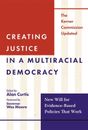
Creating Justice in a Multiracial Democracy: New Will for Evidence-Based Policies That Work
is a book published by Teachers College Press in late 2024. Edited
by Dr. Alan Curtis, President and CEO of the Milton S. Eisenhower Foundation, this work acts as a modern update and companion volume to the landmark 1968 Kerner Commission Report.
The book brings together experts, activists, and policymakers to look at what has changed since 1968 and what steps we must take next.
Core Goals
- Use Evidence: Focuses on science and proven facts instead of political campaign talk or misinformation.
- Build Political Will: Seeks to inspire leaders and citizens to reduce poverty and racial injustice.
- Promote Healing: Encourages empathy, truth, and civil conversations across different communities.
Key Issues Addressed
- Economics and Housing: Looks at ways to close the wealth gap and make housing fair for everyone.
- Education and Youth: Explores better ways for schools and universities to support local neighborhoods.
- Police Reform and Justice: Updates strategies for fair criminal justice systems.
- The Arts: Suggests using art and monuments to bring people together with hope, much like Harry Belafonte's vision.
Healing Our Divided Society: Investing in America Fifty Years after the Kerner Report
is a 2018 book edited by Fred Harris (the last surviving member of the original 1968 Kerner Commission) and Alan Curtis (CEO of the Eisenhower Foundation). It revisits the landmark 1968 Kerner Report – which famously warned that America was moving toward "two societies, one black, one white – separate and unequal" – to
evaluate what progress or regression has occurred over the last half-century.
Core Themes and Findings
- Persistent Inequality: The volume argues that many U.S. communities still suffer from deep racial tensions, high poverty, segregation, and economic disparity.
- Shared Interests: It unites the concerns of racial minorities and working- and middle-class white Americans, showing how economic stagnation impacts both groups.
- Evidence-Based Solutions: Rather than offering quick fixes, the book outlines proven, practical policies that have worked in the past.
Key Policy Areas
- Employment & Education: Recommends expanding job creation and upgrading schooling opportunities in under-resourced neighborhoods.
- Housing: Focuses on eliminating residential segregation and expanding fair housing access.
- Criminal Justice: Proposes reforms to address mass incarceration and rebuild trust between communities and law enforcement.